 |
| Shire Hall, Innisfail, 2021. Photo: Trisha Fielding. |
Barron Valley Hotel - Atherton
Designed by the architectural firm of Hill & Taylor, this two-storey brick hotel was built in 1938. It replaced the timber hotel (of the same name). It is notable for its original Art Deco features and styling.
 |
| Fireplace in the dining room of the Barron Valley Hotel, Atherton, 2021. Photo: Trisha Fielding. |
 |
| Barron Valley Hotel, Atherton, 2021. Photo: Trisha Fielding. |
 |
| Interior, Barron Valley Hotel, Atherton, 2021. Photo: Trisha Fielding. |
 |
| Interior - Barron Valley Hotel, Atherton, 2021. Photo: Trisha Fielding. |
Shire Hall - Innisfail
Built in the 1930s, the monumental Shire Hall in Innisfail totally dominates the streetscape. Completed in 1938, it was constructed by the Van Leeuwen brothers. Sadly, one of the brothers, Bill, died in an accident on site during construction the previous year. This three-storey building, built of reinforced concrete, was designed by architects Hill & Taylor. Three shire halls had existed on this site before this one was erected - and all had been destroyed by fire.
 |
| Upper level detail, Shire Hall, Innisfail, 2021. Photo: Trisha Fielding. |
 |
| Street view, Shire Hall, Innisfail, 2021. Photo: Trisha Fielding. |
Former Blue Bird Cafe - Innisfail
Built in 1936, to replace an earlier timber cafe, this building featured a cafe at street level and a dance hall/function room on the upper level.
 |
| Upper level detail, former Blue Bird Cafe, Innisfail, 2021. Photo: Trisha Fielding. |
Former Plaza Theatre - Tully
Built in 1940 and officially opened in December, this building replaced an earlier picture theatre on this site that had been destroyed by fire in June of that year.
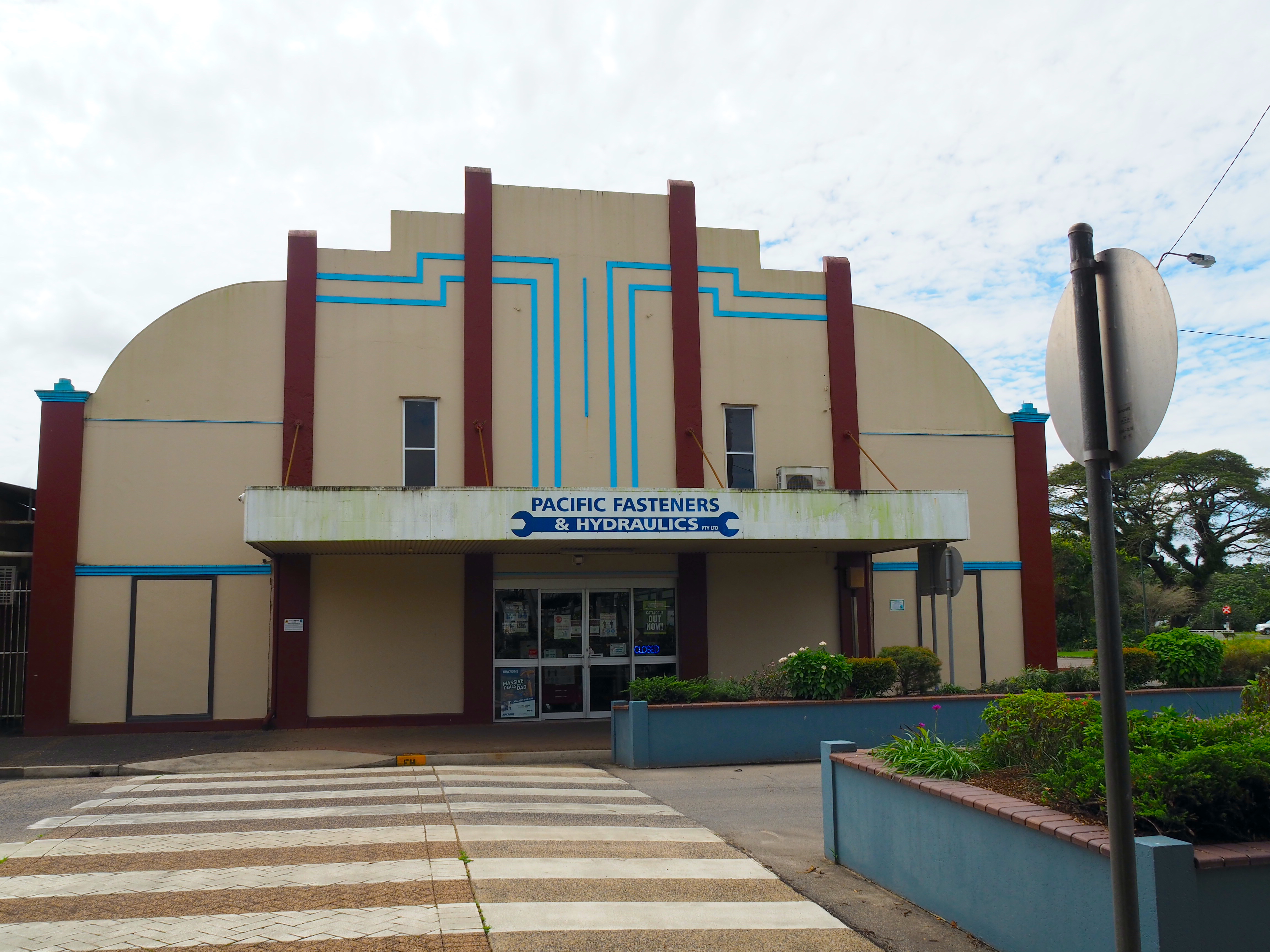 |
| Former Plaza Theatre, Tully, 2021. Photo: Trisha Fielding. |
St. Monica's High School - Cairns
Built in the Moderne style of architecture, this building for St. Monica's High School in Abbott Street, Cairns, opened in 1941. Designed by architect V.M. Brown, the reinforced concrete building has a minimum of decoration, but features the sweeping horizontal lines and curves characteristic of the style. Brown's design allowed for a future third storey to be added, though this never eventuated. The building now serves as the school's administration block.
 |
| St. Monica's High School, Cairns, 2021. Photo: Trisha Fielding. |
Town Hall - Ravenshoe
Designed in 1954 by architects Sidney Barnes and Edwin (Eddie) Oribin, this Art Deco gem is a delightful surprise, hidden away in Ravenshoe - Queensland's highest town.
 |
| Town Hall, Ravenshoe, 2021. Photo: Trisha Fielding. |
Moduline building - Ingham
I don't actually know what this building was originally, but it's got some lovely Art Deco lines.
 |
| Moduline building, Ingham. Photo: Trisha Fielding. |
Former Pacific Ice Cream building - Townsville
This building facade dates to the late 1930s. I'm yet to find out who designed (or built) this building, but I suspect it may have been architect A.V.H. Needham, as he was active in Townsville at this time. I'd be happy to hear from anyone who knows more! I do know that there was originally a clock on the front of this building, and permission for this had to be obtained from the local council first.
 |
| Former Pacific Ice Cream building, Flinders Street, Townsville, 2021. Photo: Trisha Fielding. |
Please note, I have not deliberately left out Mackay and it's fabulous Art Deco buildings, it's just that I have not yet been able to visit and photograph any of them myself. If you're interested in checking out what's in Mackay, I recommend you visit this site: https://www.mackayartdeco.org
And one last Honourable mention...
North Gregory Hotel - Winton
Okay, so this is not technically within the geographical (latitudinal) boundaries of what is considered to be "North Queensland", but this is too beautiful a building to leave it out of this post.
 |
| Interior of the North Gregory Hotel, Winton, 2021. Photo: Trisha Fielding. |

