Showing posts with label Stephen Harvey. Show all posts

Tuesday, 20 October 2015

Creelman Memorial Hall

The foundation stone for the Creelman Memorial Hall, once located in Harold Street, West End, was laid on 16 April, 1921. Designed by Townsville architect Stephen Harvey, the building was purpose-built to accommodate Presbyterian Sunday School pupils.
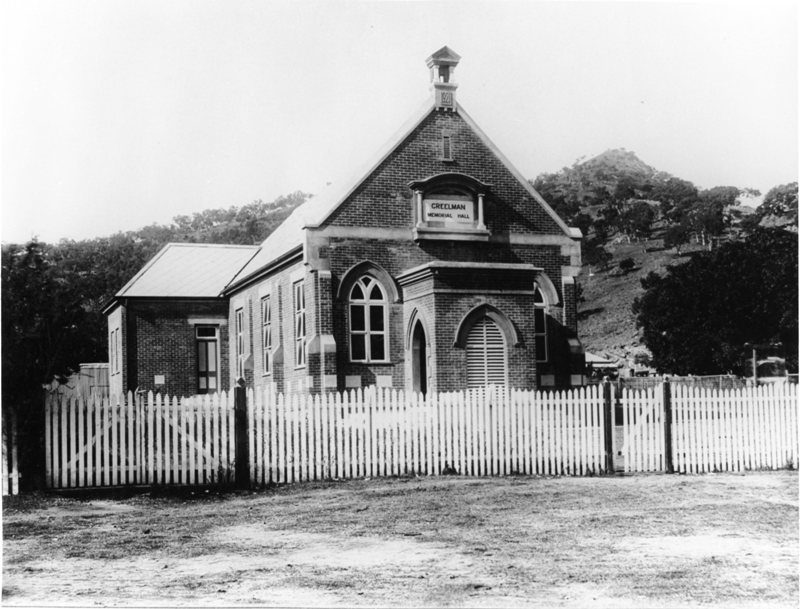
Creelman Memorial Hall, West End, Townsville, 1924.
Photo: Townsville City Libraries.
William Marshall Creelman, to whom the building was erected as a memorial, died after a brief illness in December 1919. Mr Creelman was a very prominent member and office holder in the Presbyterian Church, having become a member in 1894, an elder in 1896, and Session Clerk in 1897. He was also Treasurer of the church and served 24 years as Superintendent of the Sunday School he started at his own home in West End.

The Townsville Daily Bulletin reported in October 1916, that, “for several years, by the kindness of Mr Creelman, Sunday School had been held on the verandahs of his house, and now there were between 70 and 80 scholars, it was time they had a hall”. After several years of fundraising, work finally began on the hall.

The Rev. W. Sinclair, presiding at the ceremony to lay the foundation stone for the hall in 1921, explained that the building was an extension of a great work established in the district by the late Mr Creelman. The proceedings opened with the singing of the 100th Psalm, followed by a prayer.

The Mayor, Alderman W.H. Green, and Mr S.M. Hopkins, of the business firm Hollis Hopkins; laid two principal foundation stones.

Alderman Green said he regarded it as an honour and a privilege to be asked to lay the first stone in connection with the building, intended for God’s work in the training of youth, and as a memorial to one who had done so much for the boys and girls of that neighbourhood. He believed that “the greatness of the British Empire depended upon its homes, churches and schools, which built the character of the boys and girls”.

Miss Dorothy Swenson then presented the Mayor and Mr Hopkins with miniature polished mallets, with silver inscriptions, as a memento of the occasion. Other inscribed stones were then laid by a number of others representing various branches of church work, including one laid by Mrs Creelman.

Afternoon tea and “dainty refreshments” were provided by a committee of ladies in a temporary marquee on the grounds.

Mr Creelman, who made a living as an accountant, was evidently very highly thought of in secular circles as well. Mr S.M. Hopkins, who laid the second foundation stone, said he had known and worked with the late Mr Creelman for 15 or 16 years. During the time they had worked together he said he had personally seen a side of Mr Creelman that few other people had seen.

While many people knew Mr Creelman well from his church work or Sunday school work, Mr Hopkins knew him through his everyday work in business, and he felt that “in that character no one could wish for a more loyal and true man”.

Mr Hopkins felt sure that Mr Creelman could not have wished for a finer memorial than the hall.
Demolition of Creelman Memorial Hall, 17 July 1972.
Photo: Townsville City Libraries.

The Rev. G. Galloway officially opened the W. Creelman Memorial Hall on 23 August, 1921. The building was destroyed during Cyclone Althea in 1971 and demolished in 1972.


Sunday, 12 April 2015

Soldiers' Memorial Gate

The staggering loss of life suffered during World War I, and the national grief that followed it, sparked an ever-increasing trend towards the public memorialisation of our war dead, and the memorials that were erected to honour soldiers who served and died in the Great War became sites of shared mourning.
The opening of the Soldier's Memorial Gate, Townsville West State School, Townsville, December 1921.
Image: State Library of Queensland.
In Townsville, the first public memorial to local soldiers who served in World War I was erected not on public property, but on the grounds of a local State school, in December 1921.

The Soldiers’ Memorial Gate, at the former Townsville West State School on Ingham Road was built to honour the former students of the school who served in the Great War.  Designed by architect Stephen Harvey, and built by Messrs Melrose and Fenwick, the Memorial Gate cost £430 to erect, which was a substantial sum for that time.

Standing at close to five metres tall, the free-standing masonry archway contains marble tablets inside the supports of the gate that are inscribed with the names of 200 former pupils that enlisted for the war.  Of this number, 20 died in the service of their country, 31 were wounded, two were gassed and one was taken a prisoner of war.  On the cornice of the masonry gate, are the words “Their Name Liveth For Ever”, and the dates 1914 and 1919 appear on opposing piers.

The Memorial Gate was officially unveiled in front of a large crowd by the Mayor, Alderman W.H. Green, who, according to the Townsville Daily Bulletin gave an “impressive speech”, in which he attempted, probably unnecessarily, to justify the need for such a memorial.

Alderman Green believed that “from time immemorial it had been a custom amongst all people to set up tokens of remembrance - in the stately monuments, arches, statues of magnificent edifices in order to commemorate and have in remembrance the glorious deeds, remarkable achievements, enduring courage, noble sacrifices and nobility of character of their sons and daughters.”

With regard to this Memorial Gate, Alderman Green said the community was “well proud” of the 200 “brave lads” who had been connected with the school and that he personally felt proud to have been associated with the first committee who put forward the idea for “such a worthy monument, the first public memorial monument erected in Townsville.”

And in a touching tribute to the mothers of the soldiers who had been memorialised, Alderman Green went on to say that they “could not fail to perceive in the memorial a recognition of the sacrifices willingly and ungrudgingly borne by the noble womanhood of this Commonwealth of theirs – sacrifices often times overlooked, frequently unrecognised but none the less magnificent for all that.”

“They did not sorrow without hope, they did not weep with regret and despair, for the sorrow and tears were overwhelmed with the sense of pride and admiration,” he said.

The memorial at the Townsville West State School pre-dated the Soldiers’ Memorial (now more commonly called the Cenotaph) on the Strand by two years, although planning for the Soldiers’ Memorial was underway from as early as 1918.
ANZAC Day ceremony, Townsville West State School, April 1971.
Image: CityLibraries Townsville Local History Collection.
The types of war memorials that have been dedicated in north Queensland since the early 1900s up until the present day are many and varied. They include: memorial gates, arches, fountains, flagpoles, gardens, swimming pools, trees, sports ovals, halls and public buildings.