The former Townsville
Post Office, with its imposing clock tower, is a well-known landmark in
Townsville, and was built in stages between 1886 and 1889.
 |
| The former Townsville Post Office, with its original clock tower, c. 1900. Photo: State Library of Queensland. |
It was designed by the
Queensland Colonial Architect, John James Clark, who also designed other
buildings in north Queensland, including the courthouses in Charters Towers and
Mackay, a hospital in Innisfail, and the Townsville Railway Station, which was
completed in 1913.
The first stage of
the two-storeyed, rendered brick Post Office was intended for use as a
telegraph office and was completed at a cost of almost £6,000. The second
stage of the building cost just over £8,000. This section of the building
contained a post office and Postmaster’s room on the ground floor.
At that time, the
staff of the post office consisted of just six employees. The top floor was a
residence for the Postmaster and comprised five bedrooms, a kitchen, drawing
room, dining room and bathroom.
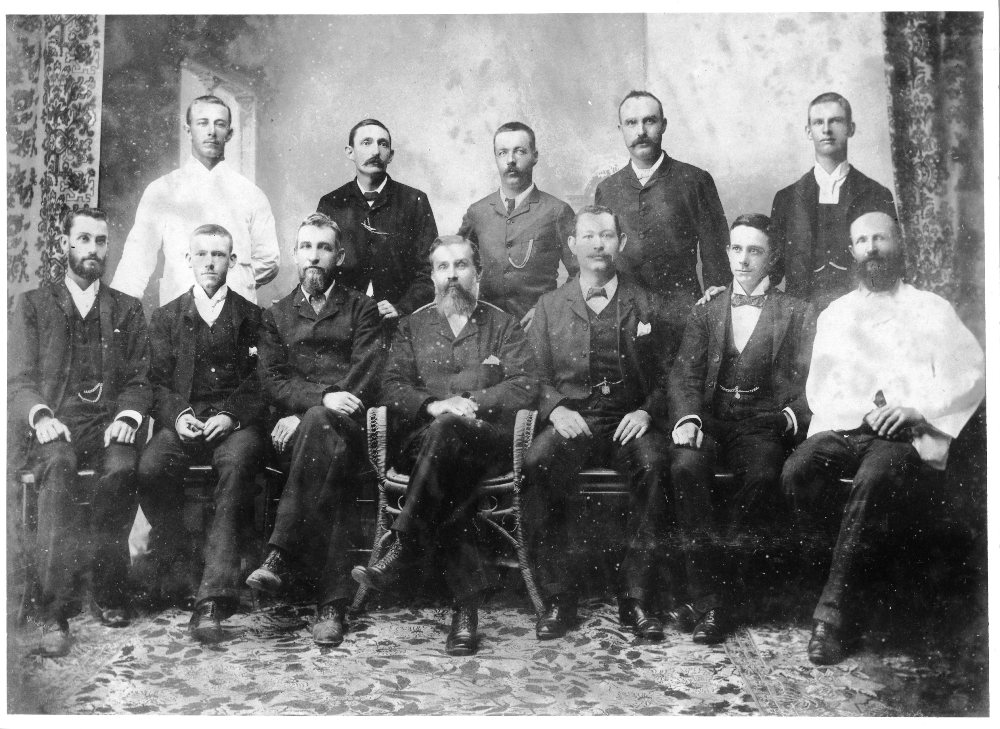 |
| Post Office staff, Townsville, 1895. Back row L to R.: J. Cuthbert, G. Fuller, J.Hone, C. Johnston, J. Nelson. Front row L to R.: W. Foster, J. Mathews, D.C. MacPherson, E. Da'Costa (Postmaster), D. Ryan, M.K. Judge, A. Monteith. Photo: CityLibraries Townsville Local History Collection. |
The residence provided
for the Postmaster was considered “palatial” at the time and drew criticism
from local public spokesmen who often met outside at the corner of Flinders and
Denham Streets to give politically motivated speeches.
Questions were raised
as to “why the glorified civil servants should be provided with such
accommodation, whilst the wives and families of the orators had to put up with
humble residences in South Townsville or any of the other distant suburbs”.
The building was
completed in 1889 with the construction of an ornate clock tower at a cost of
£245. The clock chimes were imported from England and were in use by 1891.
The post office clock
proved quite costly to maintain. In 1913 the annual cost of repairs, lighting
and winding of the clock was £54. The city council had looked into the costs
the previous year and found that no one seemed to know exactly when it had been
agreed to foot the bill for the clock, only that it had an agreement with local
jewellers Horn and Petersen to wind and keep the clock in good order.
After the bombing of Darwin
in February 1942, the clock tower on the Townsville Post Office was dismantled
and put into storage. As a recognisable landmark, and a communications centre,
it was considered a potential target for enemy bombs.
In March 1947 the
Chamber of Commerce lobbied the Commonwealth Government for the restoration of
the Post Office clock tower, arguing:
“With the surplus
millions of the PMG Department, the Commonwealth Government could well afford
to restore the town clock at the Townsville Post Office.”
The Chairman of the
Chamber of Commerce, a Mr Lawrence, said that the tower encasing the clock had
been a thing of architectural beauty, and he thought they should press for the
restoration of the tower instead of having a clock installed anywhere else on
the building.
 |
| Former Townsville Post Office, decorated for Jubilee Carnival Week, 1913. Photo: CityLibraries Townsville Local History Collection. |
Disappointingly, only
a month later, the PMG Department informed the Chamber of Commerce that it was “not
the intention of the Department to re-erect the tower and clock on the
Townsville Post Office building in the immediate future.”
 |
| Flinders Street, Townsville, 1969. The former Post Office on the left, has its post-war clock tower. Photo: CityLibraries Townsville Local History Collection. |
It was not until the
early 1960s that a new, modified clock tower was built, at a cost of more than
£42,000.


