Showing posts with label Cairns. Show all posts

Wednesday, 28 June 2023

A Whistle-stop Tour of Art Deco in North Queensland

North Queensland is home to dozens of fabulous examples of Art Deco buildings. Innisfail and Mackay both have the largest concentrations of Art Deco, and as a consequence, tend to get the most attention, but other cities have beautiful examples too. Here's a look at a small selection of buildings that I've photographed (and fell in love with!) in the past couple of years. 

Shire Hall, Innisfail, 2021. Photo: Trisha Fielding.

Barron Valley Hotel - Atherton
Designed by the architectural firm of Hill & Taylor, this two-storey brick hotel was built in 1938. It replaced the timber hotel (of the same name). It is notable for its original Art Deco features and styling.

Fireplace in the dining room of the Barron Valley Hotel, Atherton, 2021. Photo: Trisha Fielding.

Barron Valley Hotel, Atherton, 2021. Photo: Trisha Fielding.

Interior, Barron Valley Hotel, Atherton, 2021. Photo: Trisha Fielding.

Interior - Barron Valley Hotel, Atherton, 2021. Photo: Trisha Fielding.


Shire Hall - Innisfail
Built in the 1930s, the monumental Shire Hall in Innisfail totally dominates the streetscape. Completed in 1938, it was constructed by the Van Leeuwen brothers. Sadly, one of the brothers, Bill, died in an accident on site during construction the previous year. This three-storey building, built of reinforced concrete, was designed by architects Hill & Taylor. Three shire halls had existed on this site before this one was erected - and all had been destroyed by fire.

Upper level detail, Shire Hall, Innisfail, 2021. Photo: Trisha Fielding.

Street view, Shire Hall, Innisfail, 2021. Photo: Trisha Fielding.

Former Blue Bird Cafe - Innisfail
Built in 1936, to replace an earlier timber cafe, this building featured a cafe at street level and a dance hall/function room on the upper level.

Upper level detail, former Blue Bird Cafe, Innisfail, 2021. Photo: Trisha Fielding.

Former Plaza Theatre - Tully
Built in 1940 and officially opened in December, this building replaced an earlier picture theatre on this site that had been destroyed by fire in June of that year.
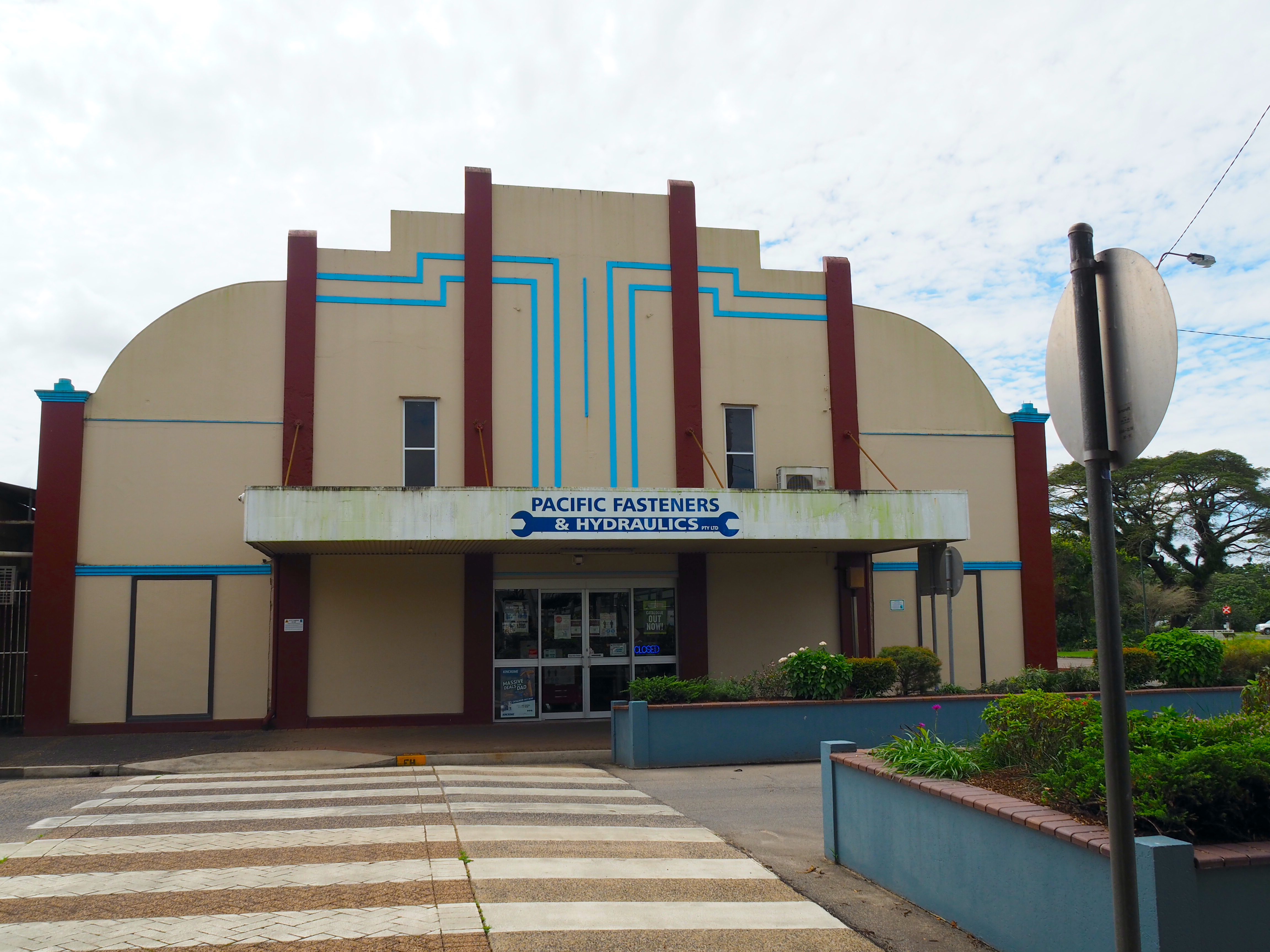
Former Plaza Theatre, Tully, 2021. Photo: Trisha Fielding.


St. Monica's High School - Cairns
Built in the Moderne style of architecture, this building for St. Monica's High School in Abbott Street, Cairns, opened in 1941. Designed by architect V.M. Brown, the reinforced concrete building has a minimum of decoration, but features the sweeping horizontal lines and curves characteristic of the style. Brown's design allowed for a future third storey to be added, though this never eventuated. The building now serves as the school's administration block.

St. Monica's High School, Cairns, 2021. Photo: Trisha Fielding.


Town Hall - Ravenshoe
Designed in 1954 by architects Sidney Barnes and Edwin (Eddie) Oribin, this Art Deco gem is a delightful surprise, hidden away in Ravenshoe - Queensland's highest town.

Town Hall, Ravenshoe, 2021. Photo: Trisha Fielding.

Moduline building - Ingham
I don't actually know what this building was originally, but it's got some lovely Art Deco lines.

Moduline building, Ingham. Photo: Trisha Fielding.

Former Pacific Ice Cream building - Townsville
This building facade dates to the late 1930s. I'm yet to find out who designed (or built) this building, but I suspect it may have been architect A.V.H. Needham, as he was active in Townsville at this time. I'd be happy to hear from anyone who knows more! I do know that there was originally a clock on the front of this building, and permission for this had to be obtained from the local council first.

Former Pacific Ice Cream building, Flinders Street, Townsville,  2021. Photo: Trisha Fielding.

Please note, I have not deliberately left out Mackay and it's fabulous Art Deco buildings, it's just that I have not yet been able to visit and photograph any of them myself. If you're interested in checking out what's in Mackay, I recommend you visit this site: https://www.mackayartdeco.org

And one last Honourable mention...

North Gregory Hotel - Winton
Okay, so this is not technically within the geographical (latitudinal) boundaries of what is considered to be "North Queensland", but this is too beautiful a building to leave it out of this post. 


Interior of the North Gregory Hotel, Winton, 2021. Photo: Trisha Fielding.

Friday, 14 June 2019

Influenza outbreaks remembered - 100 years on

2019 marks the centenary of the outbreak of Influenza in North Queensland in 1919. It was the same illness that had been sweeping the globe since the end of the First World War and would ultimately go on to claim the lives of somewhere between 50 million and 100 million people worldwide. The virulent form of pneumonic influenza - known as "Spanish Influenza" - reached Australia in early 1919, coinciding with the return of the soldiers of the AIF to Australia. 
SS Morialta. Photo: State Library of South Australia B-61166.
In May 1919, cases of Influenza were reported in Townsville. Passengers aboard the steamship Morialta were thought to be the source of infection.[1] Free inoculation against the disease was offered and 6,000 locals took up the offer. Dr Walter Nisbet, Townsville's Medical Officer of Health, estimated that somewhere between 6,000 and 7,000 of Townsville's citizens (or 25 per cent of the population) contracted the illness in some form.[2] Eighteen people died in the outbreak, ten of those in hospital and eight in private homes. 

As in other cities throughout Australia, strict rules were imposed on Townsville's population to try and curb transmission of the illness. Public meetings were banned, picture theatres and schools were closed and the main city streets were sprayed with disinfectant. Townsville North State School (now Belgian Gardens State School) was requisitioned for use as an isolation hospital. The Army supplied and erected tents in the school grounds. Over a period of ten weeks, a total of 195 patients were treated at the makeshift hospital. A second isolation hospital was opened at St. Anne's School in June and remained in use for one month and three days. During that time, 108 patients were treated there.[3]

In a letter to the Mayor of Townsville dated 15th August 1919, Dr Nisbet praised the efforts of the Matron in charge of the isolation hospital at Townsville North State School - Hannah Sarah Pengelly. He wrote: 
"The ideal and harmonious working of this hospital, chiefly with a band of young untrained workers, shows what women can do in an emergency. A large share of praise is also due to the tactful and untiring energies of the matron – Nurse Pengelly."[4]
Matron Pengelly is buried in the West End Cemetery in Townsville.

Headstone of Hannah Sarah Pengelly, died 6 December 1940. Photo: T. Fielding
In Cairns, the outbreak began in June 1919. Again, the carrier was from a steamship in port, though this time it was the ship's Captain, not a passenger, that had the virus. Captain Tyree, of the SS Allinga, was not diagnosed with Influenza until after he had spent a full day in the city, and within just days, twenty cases had been reported.[5]
SS Allinga. Photo: State Library of South Australia PRG 1324788
An isolation hospital, set up in the Girls State School, began taking in patients on 11 June.[6] Matron Mary Gliddon, who had recently moved to Cairns after having left the Mareeba Hospital, volunteered her services as matron of the isolation hospital. She was assisted by Sister Middleton, of the Cairns District Hospital, with Dr Elliott the doctor in charge. By early July, both Matron Gliddon and Dr Elliott (along with four volunteer nurses) had contracted the illness, and were too ill to carry out their duties.[7] This prompted an urgent call for women in the district to volunteer for nursing and domestic duties at the isolation hospital. A report in the Cairns Post on 4 July 1919 implored women, particularly women with no family or domestic responsibilities, to come forward, remarking that:

"the work of the authorities, however comprehensive, cannot be brought to fruition without the special skill that women's effort alone can supplement it with."[8]
By late July, 60 people were being treated for Influenza in the isolation hospital.[9] According to historian Patrick Hodgson, in the three months that Cairns battled the epidemic, there were (officially) 1007 cases of Influenza, resulting in ten deaths.[10]

The isolation hospital at the Girls School was closed in late September 1919. Matron Gliddon went on to run her own private hospital - St. Anthony's Private Hospital - in Cairns, with the help of her mother, Nurse Margaret Gliddon.


[1] Townsville Daily Bulletin, 26 May 1919, p. 4
[2] Townsville Museum collection
[3] Townsville Daily Bulletin, 16 July 1919, p. 6
[4] Townsville City Libraries Local History Collection
[5] Hodgson, Patrick, 'Flu, society and the state: the political, social and economic implications of the 1918-1920 influenza pandemic in Queensland', unpublished PhD thesis, 2017, James Cook University, p. 217.
[6] Cairns Post 12 June 1919, p. 4.
[7] Cairns Post 4 July 1919, p. 4.
[8] Cairns Post 4 July 1919, p. 5.
[9] Northern Herald 30 July 1919, p. 10.
[10] Hodgson, Patrick, 'Flu, society and the state', p. 18

Monday, 1 August 2016

Queensland Railway Ambulance Corps

The Queensland Railway Ambulance Corps was established in 1892 to train railway employees in first aid. It was considered that railway employees, because of the nature of their employment, were “especially liable to accident, and that the knowledge of the elementary rules of the treatment to be followed to preserve life and prevent undue suffering,” was likely to be of great value to them, as they were often situated far from medical assistance.

Members of the Queensland Railway Ambulance Corps (Bowen team) competing for the Commissioner's Shield in the State Final of the annual first aid competition, Brisbane, October 1939. They are seen here constructing a makeshift stretcher.
Photo: Private Collection.
Annual competitions to test the first aid skills of members of the Corps were held from 1914. Teams from all over Queensland proudly represented their region. One north Queensland team – the Bowen team - was extremely successful in the annual first aid competitions in the late 1930s.

In September 1939, the Bowen team defeated Charters Towers, Hughenden and Townsville at Rollingstone, before going on to defeat Cairns, Innisfail, Kuranda and Alma Den at the regional final in Cairns. The team members consisted of Messrs E. Moore (Captain), I.A. Fielding, F.R. Andrews, P. Herlihy and R. Ryan (patient). Team member Ivan Fielding won the individual contest, with 53 points, over W. Ross of Alma Den, and G.A. Bell, of Cairns.

The Bowen team then went on to compete against four other teams for the Commissioner’s Shield, in Brisbane, in October. The competition involved a number of set tasks, including making improvised stretchers from whatever material could be obtained. Each team member was allowed one pocket-knife, and each team was allowed one tomahawk (to be used for splitting saplings). Team members could also use their own items of clothing.
Members of the Queensland Railway Ambulance Corps (Bowen team) competing for the Commissioner's Shield in the State Final of the annual first aid competition, Brisbane, October 1939. Second from right is Ivan Fielding, who won the individual award, the St. John's Ambulance Silver Cup.
Photo: Private Collection.
You can see in the photograph above that the patient’s legs are strapped down using belts and neck ties, and that the bandaging has been made from the team members’ shirts. Even shoelaces could be used, provided they complied with the competition’s regulation length. Challenges for competitors also included an oral examination on anatomy, and carrying a “casualty” over obstacles on an improvised stretcher.

Members of the Queensland Railway Ambulance Corps (Bowen team) competing for the Commissioner's Shield in the State Final of the annual first aid competition, Brisbane, October 1939. Watching on with interest, are members of the Australian Army Medical Corps Militia, and the pipers of the 61st Battalion Queensland Cameron Highlanders, who in time of war were regimental stretcher-bearers.    
Photo: Private Collection.
Rockhampton won the shield that year, with 448 points out of a possible 530. Bowen came second, with 419 points, and Mayne Junction came third, with 410 points. But it was Bowen’s Ivan Fielding who excelled again, winning the St. John’s Ambulance Silver Cup.

Sources:
Bowen Independent, 15 September 1939; 16 October 1939.
Cairns Post, 14 September 1939.
Brisbane Telegraph, 12 October 1939.
Macno, V., Buchanan, R., and Blake, T., 'More than work', Memoirs of the Queensland Museum – Culture 5 (1), 2011, pp. 107-120.


Tuesday, 10 May 2016

NQ Midwives - "Invisible Heroines"

Hi lovely readers, I'm no longer collating information on midwives, as I published my book about this topic - Neither Mischievous nor Meddlesome - in 2019. Thank you so very much to everyone who contacted me with information, both during the research and writing phase, and since publication. I'm so grateful for the help.  

I’ve been researching and writing about midwives who lived and worked in North Queensland in the early twentieth century for a number of years now, and I have grown to have so much respect for the service and support these women provided to other women, and for their incredible work ethic.

Nurse Field, of Bowen, who ran a private hospital called Palm Cottage, c. 1916.
Photo: State Library of Queensland.
In the early 1900s, and long before giving birth in a public hospital was commonplace, many women chose to attend a “lying-in” hospital, which was a facility run by a private midwife in her own home, where a pregnant woman could go just before the baby was due to be born and remain there throughout her labour and for several days afterwards.

Many of these private midwives lacked any formal training, either in nursing or midwifery, but they were nonetheless highly respected within their communities, performing as they did, a vital, though mostly unseen, service.

There is considerable evidence to suggest that many of the women who ran these lying-in hospitals worked most of their lives as midwives. Charlotte Sherlaw ran the Garvald House Maternity Home in Cook Street, North Ward and was referred to as “Granny Sherlaw”, because of her age. Another private midwife from Townsville, Mercy Flowers, was referred to as “Granny Flowers” throughout her life, even though she had remarried after her first husband’s death, and had taken a different surname. Janet Veitch, who ran the Southesk Private Hospital in North Street, West End, appears to have been delivering babies right up until just before she died in 1927, at the age of 65. Margaret Walsh, who ran a lying-in hospital at her home in McIlwraith Street, South Townsville, only retired from her profession at the age of 74, due to ill-health.

With a population of roughly 20,000 during the years 1915 – 1918, Townsville’s private midwives were kept very busy as the city’s birth rate was high. From the reports of the city’s medical officer, it is possible to ascertain that 643 babies were born in 1915, 605 in 1916, 700 in 1917, and 780 in 1918. The 1917 birth rate for Townsville was considered to be “exceptionally high”, at 35 per thousand living. In comparison, Queensland’s birth rate for 1917 was 29 per thousand living.

Some women turned to private midwifery as a way to earn a living after being widowed. Rose Blaxland was widowed soon after marrying Colonel George Glendower Blaxland, the first paid Commandant of the Queensland Volunteer (Defence) Force, in 1899. Records show that in 1920, Rose was operating a lying-in hospital in her own home, at 24 Flinders Street, where she had lived since 1900. Rose outlived her husband by 42 years, so she used her skills as a midwife to make ends meet. Most often referred to as Nurse Blaxland, she too was later affectionately dubbed “Granny” Blaxland.

Rose Blaxland is listed on this page from the 'Register of Midwifery Nurses', held by Queensland State Archives.
Photo: Trisha Fielding.
At the same time as they made their homes available to expectant mothers, many private midwives also raised large families of their own, skilfully juggling their commitments as a wife and mother with those of a professional midwife. South Townsville midwife Margaret Walsh raised a large family while at the same time running a private lying-in hospital. Between 1887 and 1911, Margaret and her husband William, had 13 children.

During their lives, the work of private midwives went relatively unnoticed, performed, as it was, with quiet devotion and discretion. In death, these women were remembered for their enormous contribution to so many families, in newspaper obituaries that illustrate the high regard in which they were held. Rose Blaxland’s obituary from the Townsville Daily Bulletin, Friday 16 October, 1942, read:

“An old resident, Nurse Rose Isabell Blaxland, late of 24 Flinders Street West End, passed away at an early hour on Wednesday morning last, at the age of 88 years. She was born in Kent, England, in 1854, and landed in Brisbane in 1874, where she joined the nursing staff of one of the hospitals, and later became associated with the Lady Bowen Hospital and obtained her certificate for midwifery. Deceased came to Townsville in 1884 and for the last 40 years resided at 24 Flinders Street West. During her life she practised her profession and often had to travel by stage coach to carry out her duties.  Many a mother can testify to her unswerving devotion to duty and her gentle and tender kindness.”

Nurse Amy Field – Bowen

Born in Bowen in 1870, Amy Louisa Wilcox Field (see photo at top of post) trained as a nurse in Warwick for three years under Matron McNamara and later nursed in private homes in Bowen and Proserpine. She would travel to Proserpine by coach, and on at least one occasion travelled there on a railway pumper. In 1908 she opened a private hospital in Bowen called Palm Cottage, where, by the time of her retirement in 1936, more than 2,000 children had been born.

Known as “the Lady with the lamp”, this excerpt from Nurse Field’s obituary in the Mackay Daily Mercury, speaks of the high esteem in which she was held, especially by the women she nursed.

“Every one of those mothers must retain in her heart a deep feeling of gratitude - gratitude for the efficiency that gave them safety in their time of travail; for the devoted attention that she gave to them all, regardless of position; and for that loving-kindness that only the born nurse can give to her patients. Many of those mothers could tell of acts of unselfishness performed by Nurse Field on their behalf; of sleepless nights spent at their bedsides, asking no thanks; of the occasion when she rode, on a railway hand-driven tricycle to Proserpine to give her professional services. What a pity that those many kind works cannot be put into the printed word and set forth for the whole world to see, as an outstanding example of her profession. She was a true friend to all of her patients.”

Nurse Field died in August 1939, at the age of 68, only three years after retiring from nursing.

Nurse Janet Herries – Cairns

Herries Hospital, Cairns, taken sometime before 1927.
Photo: Cairns Historical Society.
Herries Private Hospital was a hospital in Cairns that catered for both maternity and general patients.  Situated at 180 McLeod Street, it was run by Nurse Janet Abercrombie Herries between 1921 and 1939. Janet was born in Glasgow, Scotland in 1869, to parents Elizabeth Drew Lang and John Mackie. In August 1900, at the age of 30, she emigrated to Australia, arriving in Rockhampton aboard the Duke of Norfolk.  In 1902 she married Robert Herries (a fellow Scotsman) in Mossman and by about 1915 they were living in Bunda Street, in Cairns, with their four sons.

As well as being an experienced and caring nurse and midwife, Janet also appears to have been a tenacious businesswoman who was not afraid to stand up for herself. In 1920, Janet sued a Mt Garnet man named Frederick Christensen for his daughter’s debt. Clara Christensen had a baby at Nurse Herries' hospital but the bill went unpaid. Christensen claimed that Clara was not his daughter, and that he had only “lived with her mother”. 

Interestingly, despite her long career as a nurse, Janet’s profession was only ever listed on electoral rolls as “home duties”, though she worked right up until the age of 70.


Sources:

· Various memoranda from City Inspector to Town Clerk, Townsville Museum
· Burial Registers: West End Cemetery and Belgian Gardens Cemetery
· Townsville Daily Bulletin
· Cairns Post
· Daily Mercury (Mackay)
· Ancestry.com
· Queensland Heritage Register
· Reports of City Medical Officer, various years, held by Townsville Museum
· Year Book Australia, 1921 (covers birth stats between 1901-1920)


Thursday, 8 January 2015

Herries' Private Hospital - Cairns

In Queensland in the early 1900s many women gave birth either in their own home or at a private hospital.  Some of these private hospitals were known as "lying-in" hospitals, and were run by nurses with midwifery experience, in their own homes.  Some private hospitals catered for both maternity as well as general patients.
This photo of Herries' Private Hospital was taken sometime before 1927.  The two boys on bicycles are sons of Janet and Robert Herries (at left is Jim and at right is Gib).
Photo: Cairns Historical Society.
Herries' Private Hospital was a private hospital in Cairns that catered for both maternity and general patients.  Situated at 180 McLeod Street, it was run by Nurse Janet Abercrombie Herries between 1921 and 1939.

Janet was born in Glasgow, Scotland in 1869, to parents Elizabeth Drew Lang and John Mackie.  In August 1900, at the age of 30, she emigrated to Australia, arriving in Rockhampton aboard the Duke of Norfolk.  In 1902 she married Robert Herries (a fellow Scotsman) in Mossman and by about 1915 they were living in Bunda Street, in Cairns, with their four sons: Robert John Mackie Herries, b. 1904; Charles Albert Herries, b. 1906; James McLeod Herries, b. abt. 1911; Gilbert Lang Herries, b. 1913.  

Here's a link to a photo of Janet & her sons on Flickr:
  https://www.flickr.com/photos/cairnsregionalcouncil/5490282829/

Until the move to Cairns, Robert Herries had worked in many of the sugar mills in north Queensland, from Mackay to Mossman.  In Cairns he worked as a waterside worker, while Janet's profession was only ever listed on electoral rolls as "home duties".  This was despite her long career as a nurse - Janet worked up until the age of 70.

Herries' Hospital was for many years a household name in Cairns.  The hospital could accommodate up to ten patients at a time and women travelled from regional towns throughout far north Queensland to have their babies at Herries' Hospital, such was its reputation.

As well as being an experienced and caring nurse and midwife, Janet also appears to have been a tenacious businesswoman.  She doesn't appear to have been frightened to stand up for herself.  In 1920, Janet sued a Mt Garnet man named Frederick Christensen for his daughter's debt.*  Clara Christensen had a baby at Nurse Herries' hospital but the bill went unpaid.  Christensen claimed that Clara was not his daughter, and that he had only "lived with her mother".  

In court, Nurse Herries was asked why she was not pursuing the father of Clara's child for the confinement fees, rather than pursuing Mr Christensen.  She said that Clara had not told her who the father of the baby was, and that Mr Christensen had agreed to pay the fees when he visited Clara at Herries Hospital.  Nurse Herries even had to justify why she had taken Clara in to her care in the first place, if she could not be sure of the father of the child?  Janet told the court that when the girl came to her place she was in such a state that she could not refuse her admission.

Note to readers: new information on Clara and Mr Christensen has been submitted via the comments section below, so please do read those comments, which do build a wider picture of the situation than I had first presented here, back in 2015. - Trisha Fielding, 30 Aug. 2026.

The building itself is reputed to have been moved from Cooktown to Cairns in 1920.  It was once a retail shop, occupying a corner position on Charlotte and Walker Streets, Cooktown.  Janet originally leased the premises at 180 McLeod Street but in 1924, she bought the house.  It suffered extensive damage during a cyclone in 1927, when its roof was blown across street and into the cemetery.  The house remained in the Herries family until 1996 and recently, the house, which had become very run-down, was magnificently restored by new owners.

* Cairns Post, 6 May, 1920, p. 2. "Nursing Expenses. Small Debts Action." 

Other sources for this article include Ancestry.com; Trove; Qld Heritage Register.

Hi lovely readers, I'm no longer collating information on midwives, as I published my book about this topic - Neither Mischievous nor Meddlesome - in 2019. Thank you so very much to everyone who contacted me with information, both during the research and writing phase, and since publication. I'm so grateful for the help.  - January 2025